How to verify AI bid answers before they leave
A short checklist for UK bid teams: cite claims, check sources, split reviews, use tested calcs, and keep a named approval before leave-check.
How to verify AI bid answers before they leave
AI drafts look finished long before they are safe to submit. In UK bidding, that is the risk: polished prose can still invent a case study, misread an ITT date, or cite the wrong policy version. An APMP UK Bid Writing Focus Group survey found that more than half of respondents said AI tools had improved bid writing efficiency, while 81% named accuracy as the key concern. The fix is not “read everything harder.” It is a short, repeatable verify loop you run before leave-check.
Use this checklist on the next ITT answer set that came from AI.
Treat the AI draft as a starting point, not leave-ready
Confidently wrong content is high-risk because it sounds helpful. APMP UK’s guidance is clear: put structured human review in place for factual accuracy, traceability, compliance, client relevance, and formal approval before AI-generated content enters a live submission.
That means the AI draft is stage one of the writing process, not the leave-check. Your compliance matrix, bid library, and named reviewers still decide what leaves.
Trace every material claim to a passage
For every material claim — a date, duration, SLA, certification, case study, or policy statement — open the source. Do not approve from the AI’s wording alone.
- If the draft cites a public page, check the link works, then judge whether the source is reputable and on-point for this ITT.
- If it cites an internal document, locate the file in your bid library, confirm it is the current signed-off version, and find the passage that actually supports the claim.
- If the draft refers to a specific ITT fact (start date, word limit, evaluation weight), jump to that paragraph in the pack and match it word for word.
Pointing every claim at a passage turns “does this sound right?” into “does this passage say that?” Citations do not remove human review; they make the review possible under portal pressure.
Do not stop at the first search hit
Most search systems mix keyword match and meaning match. Generic terms (“duration”, “warranty”, “social value”) often surface a near-miss as hit one, while the right passage sits at two or three.
Best practice:
- Read the top hit, then open the second and third.
- If your keywords are broad, narrow them (buyer name + clause noun, document title + section heading) or limit the search to the ITT pack / approved library.
- Treat a tidy AI summary as a pointer, not as proof that the right document won the ranking.
Split the check into small steps
One long “does this answer feel OK?” pass misses dates, figures, and compliance gaps. Break verification the same way you break drafting:
- Compliance facts first — requirements matrix, mandatory criteria, word counts, and submission rules.
- Evidence next — case studies, CVs, certifications, SLAs: each claim against a located source.
- Voice and consistency last — win themes, buyer language, and house style.
Work one claim, date, or figure at a time. Smaller checks catch the errors that a single skim pastes into the portal.
Prefer tested tools over AI arithmetic
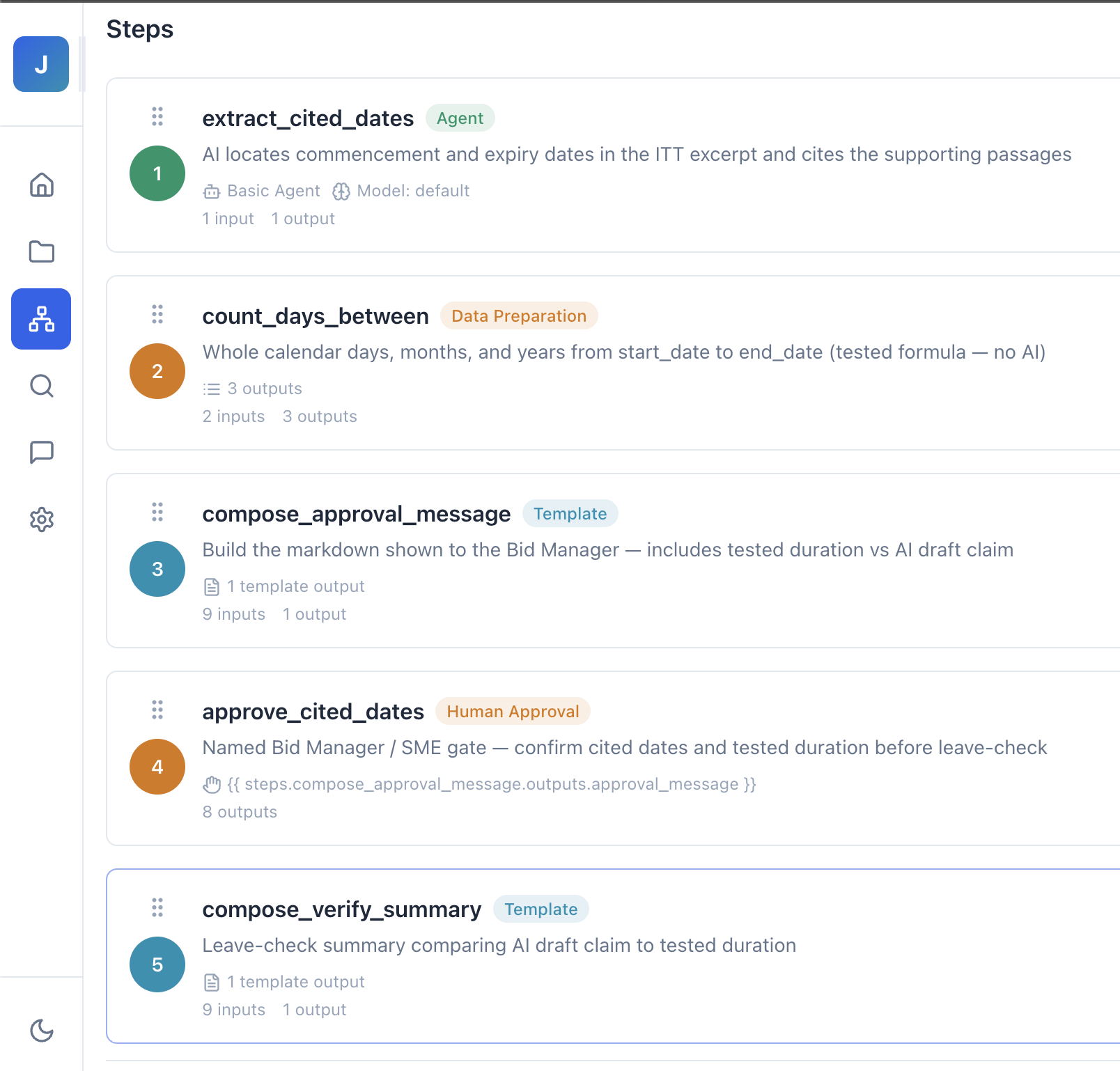
Asking the model to “work out” a figure is a common failure mode. Example: the draft says the contract runs for 18 months, but the ITT start and end dates imply 19. A free-form “how many months?” prompt can round, skip inclusive months, or invent a midpoint.
Safer pattern: change the prompt so the AI returns the cited start and end dates from the named tender document (with passage or page), add a human approval step to review those dates, then run another workflow step that uses a tested calculation tool directly — with no AI usage — to calculate the months. Keep AI for locating and drafting; keep arithmetic and date maths in tools you trust.
Risk-route and name who approved
Not every sentence needs the same depth of review. Practitioner guidance often routes legal, security, and technical claims to named SMEs while lighter narrative gets a quicker pass. One practical split:
| Risk | Typical content | Who checks |
|---|---|---|
| High | Compliance, legal, pricing, certifications, case studies and prior contracts | Named SME / Bid Manager |
| Medium | Method statements tied to commitments | Author + peer review |
| Lower | Narrative framing once facts are locked | Lighter style pass |
Before leave-check, record who approved the AI-assisted sections and when. For UK public-sector packs that follow PPN 017 disclosure practice, buyers may ask whether AI-supported tender text was checked and verified for accuracy — so a named gate is practice hygiene, not bureaucracy.
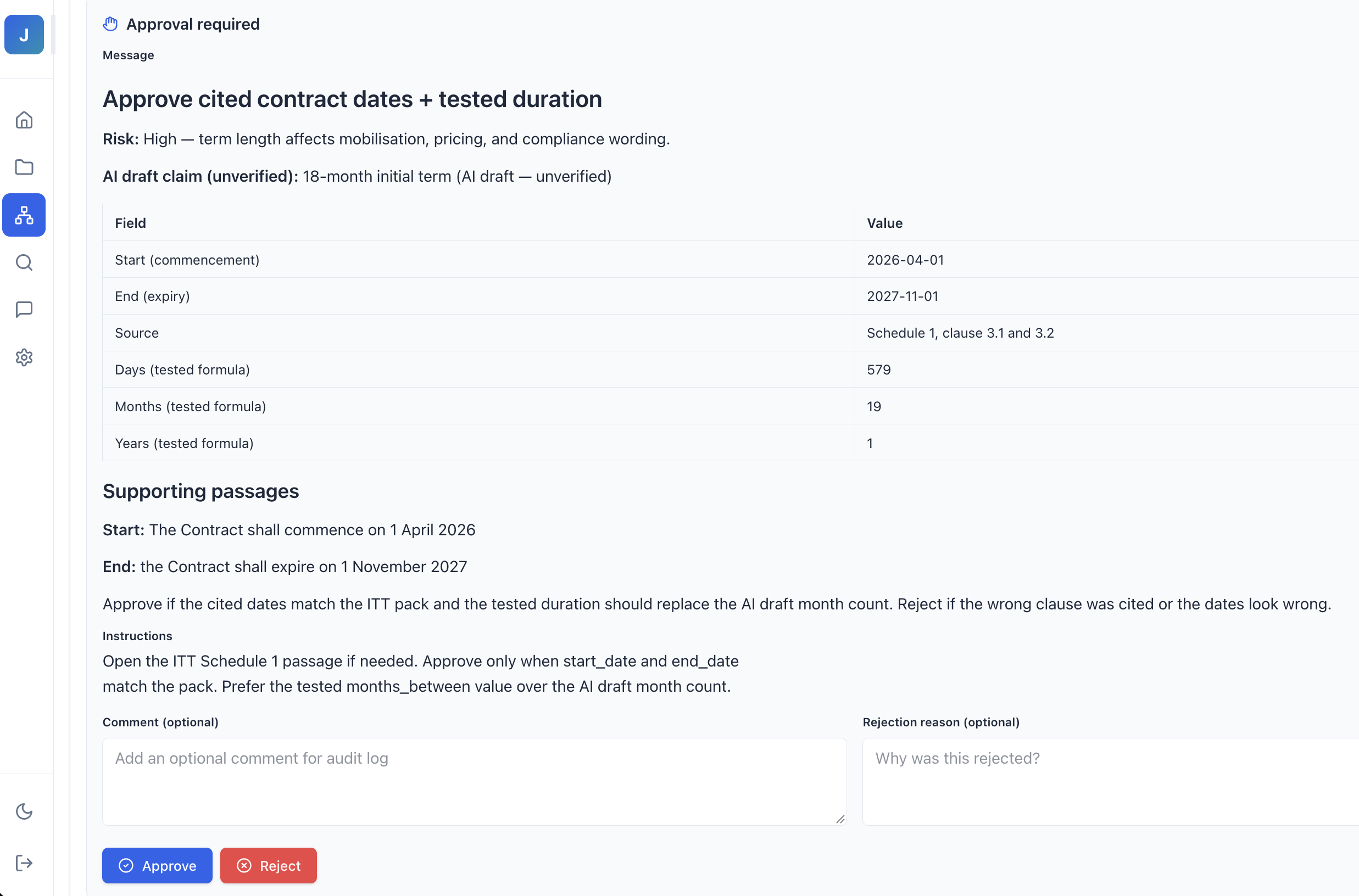
On the next ITT: run cite → open source → check second and third hits → small-step checks → tested calcs → named approve. That sequence is what protects the submission; the draft is only the input.
If you want the process on the next ITT
If you already know the checkpoints that work, the hard part is running them the same way under portal pressure. A1KnowHow is built for bid practices that need AI on the repeat work and a named approval before anything leaves.
Run the verify loop the same way every ITT
- Capture your bid stages once as runnable workflow steps—so the team does not freestyle prompts under portal pressure
- Pause for named human approval before leave-check—record who signed and when
- Put date maths and other figures in tested tool steps with no AI in that step—after a human has approved the cited inputs
- Keep AI on the repeat work (locate passages, first drafts); keep judgement and leave-check with the Bid Manager
Ground answers in your bid library
- Keep ITT packs, signed-off case studies, and policies in one workspace so reviewers can open the passage, not guess from prose
- Search with citations back to your documents—so “does this sound right?” becomes “does this passage say that?”
- Keep confidential tender packs inside your controlled environment instead of pasting them into a public chatbot
- Reuse approved library copy where it still fits—then verify freshness and buyer fit before it leaves